



Understanding Your Sleep Study Report: AHI, RDI, ODI, SpO₂, Leak (Simple Guide)
March 13, 2026 2026-03-13 15:09Understanding Your Sleep Study Report: AHI, RDI, ODI, SpO₂, Leak (Simple Guide)
Understanding Your Sleep Study Report: AHI, RDI, ODI, SpO₂, Leak (Simple Guide)
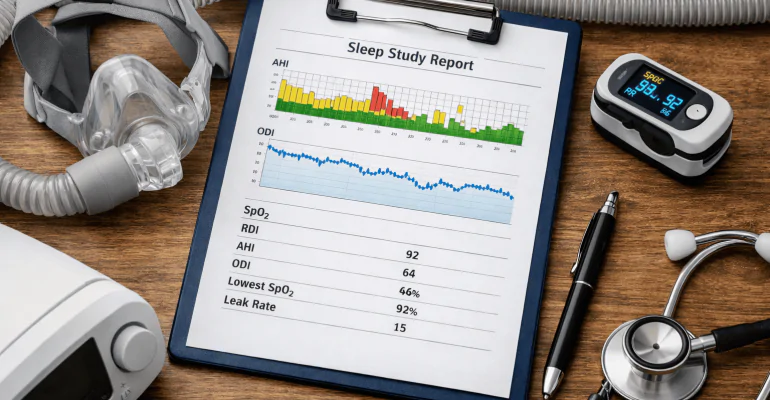
If you have just received your sleep test results and the numbers look confusing, you are not alone. Terms like AHI, RDI, ODI, SpO₂, and leak can make a sleep study report feel harder to understand than it should be. This simple guide breaks down the key terms in plain English so you know what your report is trying to tell you.
What is an AHI score in a sleep study?
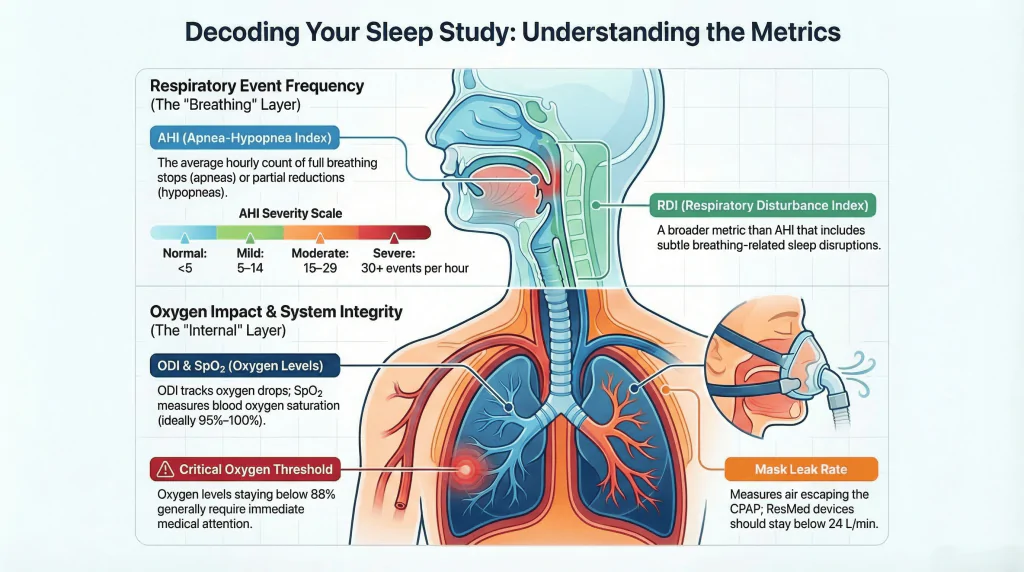
If you are searching for the AHI meaning in a sleep study, AHI stands for Apnea-Hypopnea Index. It is the average number of times per hour that your breathing either fully stops (apnea) or partially reduces (hypopnea) while you sleep. AHI is one of the main numbers used to judge sleep apnea severity. In adults, fewer than five events per hour are generally considered normal; 5 to 14 are mild; 15 to 29 are moderate; and 30 or more are severe.
Simply put, the higher your AHI, the more frequently breathing problems disrupt your sleep. That’s why doctors care about AHI scores.
RDI meaning: How is it different from AHI?
RDI means Respiratory Disturbance Index. It includes apneas and hypopneas, but it may also involve subtler breathing events that disturb sleep, such as RERAs. Because of that, your RDI can be higher than your AHI.
This measurement matters when a person feels worn out, sleepy, or unrefreshed even if the AHI does not look very high. In some reports, RDI gives a broader picture of disrupted breathing during sleep.
ODI meaning in a sleep report
ODI means Oxygen Desaturation Index. It tells you how many times per hour your blood oxygen level drops during sleep. One NIH-indexed paper defines ODI as the average number of desaturation episodes per hour, typically using drops of 3% or more that last at least 10 seconds.
Why does this number matter? Sleep apnea involves more than just airflow stopping or slowing down. It is also about what those events do to your oxygen levels. A higher ODI usually means your body is experiencing more repeated oxygen dips overnight.
SpO₂ in sleep study: what does it mean?
SpO₂ in a sleep study refers to your blood oxygen saturation. This shows how much oxygen your blood is carrying while you sleep. Healthy overnight oxygen levels are usually around 95% to 100%, though brief small drops can happen during sleep. Readings that stay low, especially below 88%, may suggest a sleep-related breathing problem and deserve medical attention.
Most reports show more than one oxygen number, such as
- Average SpO₂
- Lowest SpO₂
- Time spent below a certain level, such as 90%
If your AHI is elevated and your lowest SpO₂ is also low, that usually suggests the breathing disturbances are affecting oxygen delivery during sleep.
What does “leak” mean?
“Leak” usually refers to air escaping from the mask or CPAP system instead of going where it should. This number is most useful in CPAP titration studies or PAP therapy reports. High leak can reduce therapy effectiveness and make the data harder to interpret. ResMed guidance notes that on its devices, unintentional leak should generally stay below 24 L/min.
In real life, a high leak number can happen because:
- the mask is not fitted properly
- the mask cushion is worn out
- the wrong mask type is being used
- you move a lot during sleep
How to read your sleep apnea report quickly
If you want a fast sleep apnea report explained version, use this order:
1. Look at AHI
This tells you how often breathing events are happening.
2. Check RDI
If RDI is much higher than AHI, your sleep may be getting disrupted by additional breathing-related arousals.
3. Review ODI and SpO₂
These tell you whether your oxygen is dropping and how low it goes during the night.
4. Check for a leak if it is listed
If the leak is high, your CPAP setup may need adjustment.
Final takeaway
The easiest way to understand your report is this: AHI and RDI tell you how often breathing-related sleep disruption happens, ODI and SpO₂ tell you how much your oxygen is affected, and leak tells you whether your CPAP setup is working cleanly.
If your results show moderate or severe sleep apnea, or your oxygen drops significantly overnight, it is worth discussing treatment options with your sleep specialist. And if you are starting PAP therapy, getting the right machine and mask fit can make a major difference to comfort and long-term success.