
Popular posts
PC Based Spirometer Comparison: Clarity SpiroTech vs RMS Helios 401
October 15, 2026
Oxymed CPAP Machine Comparison: SleepEasy, SleepEasy 2.0 & AirSmart
October 14, 2026
Where to Buy a CPAP Machine in India
September 11, 2026

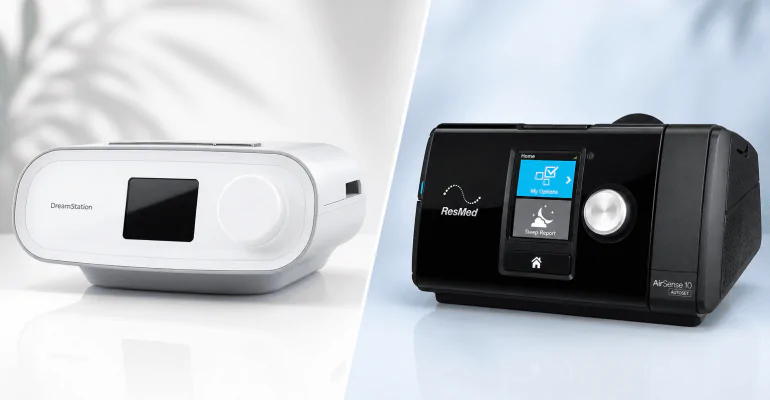
ResMed AirSense 10 AutoSet TriPack Auto CPAP vs. Philips DreamStation Auto CPAP: 2026 Guide
May 4, 2026 2026-05-04 16:04ResMed AirSense 10 AutoSet TriPack Auto CPAP vs. Philips DreamStation Auto CPAP: 2026 Guide
ResMed AirSense 10 AutoSet TriPack Auto CPAP vs. Philips DreamStation Auto CPAP: 2026 Guide
Quick Summary:
Which is better: AirSense 10 or DreamStation Auto CPAP?
- Choose AirSense 10 AutoSet if you want a more integrated system with consistent therapy and remote monitoring.
- Choose DreamStation Auto CPAP if you want easier handling, flexible setup, and a lower upfront cost.
If you are new to CPAP machines and someone has suggested the ResMed AirSense 10 AutoSet TriPack or Philips DreamStation Auto CPAP, you are not alone.
Both names come up often, and both can look confusing at first.
This guide explains the key differences in simple terms so you can understand which machine may suit your sleep therapy needs better.
Quick Comparison: AirSense 10 AutoSet TriPack vs. DreamStation Auto CPAP
| Feature | ResMed AirSense 10 AutoSet TriPack Auto CPAP | Philips Respironics DreamStation Auto CPAP |
| Therapy Type | Auto-adjusting CPAP/APAP | CPAP and Auto-CPAP |
| Pressure Range | 4 to 20 cm H₂O | 4 to 20 cm H₂O |
| Comfort Technology | AutoRamp with sleep onset detection and EPR | Flex comfort technology with modular, detachable setup |
| Humidification | Built-in HumidAir humidifier with ClimateLineAir heated tube support | Heated humidification with modular, detachable setup |
| Connectivity | Cellular connectivity | Integrated Bluetooth |
| App Support | ResMed myAir app on compatible models | Philips DreamMapper app through Bluetooth pairing |
| Design Feel | Premium, integrated and clinical | Compact, practical and user-friendly |
| Travel Convenience | Portable but more integrated as a complete unit | Lighter, compact and easier to pack |
| Best For | Users who want a premium ResMed ecosystem and provider monitoring | Users who want comfort, flexibility, Bluetooth tracking and better value |
What Is the ResMed AirSense 10 AutoSet TriPack Auto CPAP?
The ResMed AirSense 10 AutoSet TriPack Auto CPAP is a premium auto-adjusting CPAP machine designed for users who want a complete therapy package. It combines AutoSet technology, built-in HumidAir humidification and ClimateLineAir heated tube support to make overnight therapy more stable and comfortable.
Its biggest advantage is consistency. The AutoSet algorithm automatically responds to your breathing pattern and changes pressure as needed during the night. This can be useful for users whose pressure requirement changes because of sleeping position, congestion, sleep stage or mask leak. The device also includes AutoRamp with sleep onset detection, which starts therapy at a lower pressure and increases it once sleep is detected.
The AirSense 10 AutoSet TriPack also supports remote monitoring through cellular connectivity on compatible models. This makes it convenient for clinics and care providers who want to review therapy progress without depending only on manual SD card downloads. For users who prefer a premium, integrated system with strong clinical support, this is where ResMed has a clear advantage.
What Is the Philips Respironics DreamStation Auto CPAP?
The Philips Respironics DreamStation Auto CPAP is built around comfort, usability, and patient engagement. It offers CPAP and Auto-CPAP therapy modes, a 4 to 20 cm H₂O pressure range, adjustable ramp settings, heated humidification, mask fit detection, Bluetooth connectivity, and a compact body that is easy to place, clean and travel with.
Its design feels less intimidating for many first-time CPAP users. The front-facing display, easy-to-use menu structure and detachable humidifier setup make the device simple to handle on a daily basis. It is also lighter than many full-size CPAP machines, which makes it a practical choice for users who travel frequently or want a bedside device that does not feel bulky.
Another strong point is DreamMapper support through Bluetooth. Users can view therapy usage, mask fit and AHI trends, which can help them stay more engaged with therapy. For people who want a device that feels user-friendly rather than overly clinical, DreamStation has a strong practical appeal.
Comfort and Breathing Experience
Comfort is often the deciding factor in CPAP therapy. A machine may have advanced technology, but it will only help if the user can sleep with it consistently.
The AirSense 10 AutoSet TriPack uses Expiratory Pressure Relief, commonly known as EPR. This reduces pressure slightly when the user exhales, making breathing out feel easier. Combined with AutoRamp, it offers a smooth start to therapy and helps users settle into sleep before full treatment pressure begins.
The Philips DreamStation Auto CPAP uses Philips Flex comfort technology, including pressure relief at the beginning of exhalation depending on the mode and setting. This can make breathing feel more natural, especially for new CPAP users who find continuous pressure uncomfortable. DreamStation also includes SmartRamp-style comfort support that allows users to fall asleep at lower pressure before the machine gradually adjusts therapy.
In simple terms:
- AirSense 10 = more consistent and controlled
- DreamStation = more adaptive and natural-feeling
Humidification and Dryness Control
Dry mouth, nasal irritation and throat dryness are common CPAP complaints. Both machines address these issues with heated humidification, but their designs feel different in everyday use.
The AirSense 10 AutoSet TriPack includes an integrated HumidAir humidifier and ClimateLineAir heated tube support. This makes it a strong choice for users who want automatic humidity and temperature control in a single, premium setup. It is especially useful for people who experience dryness regularly or sleep in an air-conditioned room.
The DreamStation Auto CPAP offers heated humidification with a more modular design. This gives users the flexibility to use the device with or without the humidifier depending on need. For Indian users, where humidity can vary significantly between summer, monsoon and winter, this flexibility can be useful. If you do not need humidification every night, the DreamStation setup may feel easier to manage.
If you want set-and-forget comfort → AirSense 10
If you want flexibility → DreamStation
Design, Portability and Day-to-Day Use
The AirSense 10 AutoSet TriPack has a premium all-in-one design. It looks neat on a bedside table, has a colour display and keeps humidification closely integrated with the main device. The interface is simple and reliable, although the overall feel is more clinical and structured.
The DreamStation Auto CPAP has a more practical and patient-friendly design. The display is easy to view from the bedside, the menu is simple to understand and the detachable humidifier gives the unit a more flexible feel. The machine is also known for being easy to pack, making it suitable for users who travel or move between homes.
This is one of the areas where DreamStation feels stronger for daily users. It may not look as premium as the AirSense 10, but it feels convenient, manageable and less bulky in routine use.
Connectivity: Cellular vs Bluetooth
This section is important because the two machines should not be described as having the same connectivity setup.
The ResMed AirSense 10 AutoSet TriPack supports cellular connectivity on compatible models and is designed for remote therapy monitoring through the ResMed ecosystem. This is useful when doctors, sleep coaches or providers need to access therapy data and support users remotely.
The Philips DreamStation Auto CPAP has integrated Bluetooth connectivity for data tracking and DreamMapper app support. Bluetooth makes it easier for users to pair the device with a smartphone and monitor basic therapy information such as usage, mask fit and AHI trends.
AirSense 10 → better for doctor-led monitoring
DreamStation → better for basic self-tracking
Noise Level and Sleep Quality
Both machines are designed for quiet operation, which matters because CPAP therapy is used every night, often next to a sleeping partner.
The AirSense 10 AutoSet TriPack is known for its quiet Easy-Breathe motor and refined performance. DreamStation Auto CPAP is also designed for quiet therapy, with RespBuy highlighting advanced noise reduction and a compact sleep-friendly design.
In real-world use, mask fit and tubing placement often affect noise more than the device motor. A poorly fitted mask can create air leaks that sound louder than the machine itself. For best results, users should choose a properly sized mask and replace filters, cushions and tubes on time.
Price and Value for Money
Price is one of the biggest reasons buyers compare these two machines. The AirSense 10 AutoSet TriPack is positioned as a premium ResMed device. It offers excellent technology, strong monitoring support and a complete therapy package, but it usually sits at a higher price point.
The Philips DreamStation Auto CPAP is generally more value-focused. It still provides auto-adjusting therapy, heated humidification, Bluetooth tracking, mask fit detection, ramp comfort and a travel-friendly build, but often at a more accessible price.
For users who want the most polished ecosystem, the AirSense 10 AutoSet TriPack makes sense. For users who want a dependable auto CPAP machine that is comfortable, simple and easier on the budget, DreamStation may offer better overall value.
Which CPAP Machine Should You Choose?
Choose the ResMed AirSense 10 AutoSet TriPack Auto CPAP if you want a premium integrated machine, cellular connectivity, strong provider monitoring, AutoSet technology, HumidAir humidification and ClimateLineAir heated tube support. It is a strong option for users who want a complete ResMed therapy ecosystem and are comfortable paying more for it.
Choose the Philips Respironics DreamStation Auto CPAP if you want a comfortable, user-friendly, Bluetooth-enabled and travel-friendly machine with flexible humidification and strong value. It is especially suitable for first-time CPAP users, budget-conscious buyers and people who want therapy to feel simple rather than complicated.
Overall, the AirSense 10 AutoSet TriPack is the more premium and clinically integrated machine, while the DreamStation Auto CPAP is the more practical, flexible and value-orientated choice.
Final Verdict
The ResMed AirSense 10 AutoSet TriPack Auto CPAP and Philips Respironics DreamStation Auto CPAP are both capable machines for sleep apnoea therapy. The AirSense 10 stands out for its AutoSet algorithm, integrated humidification, heated tube support and cellular connectivity. It is best for users who want a premium ResMed experience with strong remote monitoring.
The Philips DreamStation Auto CPAP stands out for comfort, Bluetooth tracking, simple handling, detachable humidification and better value. It may be the more practical choice for many users because it is easier to understand, easier to travel with and easier to adapt to over time.
For 2026 buyers, they should base their decision on how they will use the machine every night. If you want the most premium integrated setup, go with AirSense 10 AutoSet TriPack. If you want a comfortable, flexible and user-friendly auto CPAP machine at a more attractive value point, the Philips DreamStation Auto CPAP is a smart choice.