


ECG Lead Connectors: Snap, Grabber, Banana & Pin
November 25, 2026 2026-11-25 7:04ECG Lead Connectors: Snap, Grabber, Banana & Pin

ECG Lead Connectors: Snap, Grabber, Banana & Pin
Check both ends before you order
ECG lead connectors describe more than the fitting at the electrode. A replacement must also match the machine or trunk-cable connection, lead configuration and coding. Start with your existing cable reference and equipment model.
Many replacement requests begin with a familiar-looking patient lead. That is useful, but it identifies only one part of the assembly. A photo of the machine-side plug and the old cable label can be just as important as a close-up of the electrode end.
Know which part you are replacing
| Part | What it does | What to check |
|---|---|---|
| Patient or trunk cable | Connects to the equipment or acquisition module | Exact equipment interface and required reference |
| Leadwire set | Connects through the appropriate cable arrangement to the electrodes | Trunk connection, lead count, coding and patient-end fittings |
| Electrodes or attachments | Provide the patient-contact attachment | Fitting required by the leads and the specified application |
Some listings supply a complete assembly; others supply only leadwires, clips or electrodes. Read the contents before choosing. A replacement cable does not automatically include the limb clamps, chest electrodes or disposable pads pictured in another listing.
Compare the patient-end fittings
| Option name | Selection check |
|---|---|
| Snap | Match the snap fitting to the electrode attachment required by the setup. |
| Pinch / grabber | Compare the clip-style attachment with the existing electrode interface. |
| Banana | Match the plug dimensions and corresponding electrode socket. |
| Needle / pin type | Check the specified fitting rather than assuming all small pin ends are equivalent. |
These names help you describe the patient-end fitting. They do not establish the machine-side connection. Our selectable lead-end options should be compared with both the existing lead and the electrode arrangement.
Match the equipment connection and lead configuration
Record the ECG machine or acquisition-module model and any cable reference. Compare the plug front, keying and contacts. A stated pin count, including 15-pin, is one check rather than a universal compatibility guarantee.
Also match the lead configuration. A five-lead patient-monitor cable and a ten-lead diagnostic ECG assembly are different products. Do not select one simply because the electrode ends look similar.
Check the required coding
Manufacturer catalogues distinguish AHA and IEC leadwire arrangements. Match the required labels and coding to the existing system and equipment instructions. Avoid choosing a replacement only by a single wire colour.
If you are replacing only the leadwire set while keeping the trunk cable, share both references. That helps distinguish a patient-end fitting change from a different acquisition-system connection.
Review the cable and electrode listings
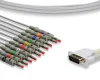
15-pin replacement 10-lead cable
Compare the machine interface and selectable Banana, Needle, Snap or Pinch/Grabber ends.

Mortara / Burdick-compatible leadwire
Match the acquisition setup, coding and patient-end option.
Need attachments rather than a cable? Review the four-piece limb clamp set or the six-piece adult chest electrode set. Confirm the fitting before pairing them with your leads.
A useful photo checklist
- Equipment brand, full model and acquisition-module reference if used.
- Machine-side plug photographed from the front.
- Patient-end fittings and lead labels.
- Existing cable or leadwire reference.
- Whether you need the complete cable, leadwires or electrodes.
Send pictures of equipment and accessories only. Patient images and recordings are not needed to identify a replacement connection.
Frequently asked questions
Will any 15-pin ECG cable fit?
No. The equipment interface, pin arrangement, keying and lead configuration must match the exact setup.
Is a snap end enough to identify the cable?
No. It identifies the patient-end fitting. Check the machine or trunk-cable end as well.
Are AHA and IEC just colour choices?
They are distinct coding arrangements. Use the one required by the equipment and procedure.
Does a leadwire set include the trunk cable?
Check the listing contents. A separate leadwire set is not automatically a complete patient cable.
What photos should I send?
Send the equipment label, both cable ends, lead labels and the existing accessory reference.
Let’s check your connection
Send our team the equipment model and photos of the label, connector and existing accessory. We can help you choose the right listing.