
Popular posts

Where to Buy a CPAP Machine in India
September 11, 2026


5 Reasons Your Under-Eyes Always Look Tired
May 06, 20265 Products That Actually Help You Sleep Better at Night
May 27, 2026 2026-05-28 22:525 Products That Actually Help You Sleep Better at Night
5 Products That Actually Help You Sleep Better at Night
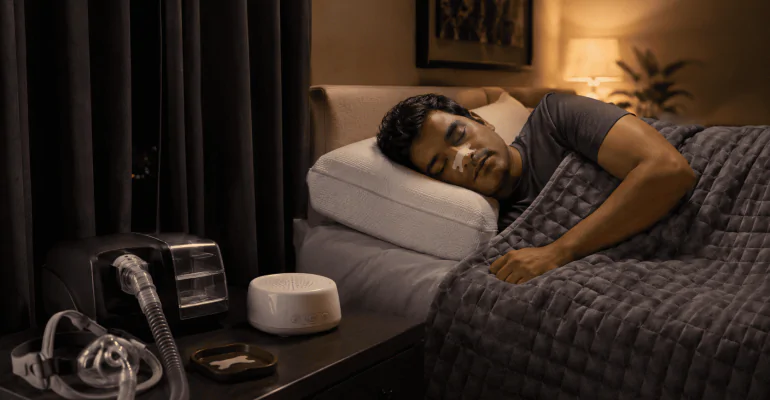
Quick Answer: The most effective products to improve sleep quality are a CPAP machine (for those with sleep apnea or heavy snoring), a weighted blanket, nasal strips, a white noise machine, blackout curtains, and an orthopedic pillow. Each one targets a specific reason your sleep is getting disrupted, whether that is breathing, noise, light, or physical discomfort. Using two or three of these together tends to make a bigger difference than any single product alone.
You have tried sleeping earlier. You have cut the evening chai. And you still wake up feeling like you barely rested.
The problem is usually not your habits. It is your sleep environment, and specifically, the things your body is fighting through every single night without you realising it.
Why Your Sleep Environment Matters More Than You Think
Your brain does not fully switch off when you sleep. It stays alert, quietly monitoring your surroundings for anything unusual. Temperature, sound, light, restricted breathing, even a pillow that holds your neck at the wrong angle. Any of these can pull you out of deep sleep repeatedly through the night.
You may not remember waking. But your body does.
The good news is that your sleep environment is one of the few things you can actually control. Here are five products that address specific, real reasons why people sleep badly.
1. CPAP Machine (If You Snore or Stop Breathing in Your Sleep)
This one is not for everyone, but if it is for you, nothing else on this list will matter as much.
CPAP stands for Continuous Positive Airway Pressure. It delivers a steady stream of air through a mask while you sleep, keeping your airway open so you do not stop breathing or choke mid-sleep. It is the standard treatment for obstructive sleep apnea, a condition that affects a significant number of Indian adults, many of whom have never been diagnosed.
Signs you might need one: loud snoring, waking up gasping, morning headaches, or feeling exhausted no matter how long you slept.
If you or someone at home has been told by a doctor to get a CPAP, it is worth getting a proper medical-grade device rather than a cheap import. Respbuy stocks a range of CPAP machines suited for home use in India, with masks, humidifiers, and accessories available separately depending on your prescription.
A CPAP machine will not fix bad sleep if your underlying issue is noise or light. But if breathing is the root problem, this is where you start.
2. Weighted Blanket
A weighted blanket is exactly what it sounds like. A blanket filled with glass beads, usually between 4 kg and 10 kg, designed to apply even pressure across your body while you sleep.
The science behind it is called Deep Pressure Stimulation. Gentle, distributed weight on the body signals the nervous system to shift out of alert mode. It increases melatonin production and brings cortisol down. The effect is similar to being held or hugged, which is why many people find it easier to fall asleep under one.
Who benefits most: people who feel restless or anxious at bedtime, those who wake frequently through the night, and anyone who just cannot seem to switch off mentally before sleeping.
A general rule is to pick a blanket that is roughly 10% of your body weight. So if you weigh 70 kg, a 7 kg blanket is a good starting point.
3. Nasal Strips
Small, inexpensive, and genuinely underrated.
A nasal strip is an adhesive strip you stick across the bridge of your nose before sleeping. It gently pulls the sides of your nasal passages open, widening the airway mechanically. No medication involved.
When nasal passages are narrow or blocked, even partially, your body switches to mouth breathing. Mouth breathing during sleep increases snoring, dries out your throat, and generally makes sleep lighter and less restful. Nasal strips address this at the source, said by Awesome Sleep Nasal Strips.
They work best for people with mild nasal congestion, seasonal allergies, a slightly deviated septum, or anyone who tends to snore but does not have full sleep apnea. If you do have sleep apnea, nasal strips can be used alongside CPAP therapy but are not a substitute for it.
4. White Noise Machine
Urban India is loud. Traffic, neighbours, the occasional pressure cooker at 6 AM. Your brain registers each sudden sound as a potential threat and pulls you toward wakefulness to assess it.
A white noise machine works by raising the baseline level of ambient sound in your room. When the room already has a steady, neutral sound floor, sudden noises do not create a sharp spike. Your brain does not react. You stay asleep.
This is different from playing music or a podcast, where your brain is actually processing content. White noise is specifically designed to be acoustically neutral.
Useful for: light sleepers, people in noisy apartments, shift workers sleeping during the day, anyone with a partner whose schedule does not match their own.
Look for a machine with multiple sound options (white noise, pink noise, brown noise, fan sounds) and a timer function so it is not running all night if you do not need that.
5. Blackout Curtains
Light is one of the most underestimated sleep disruptors.
Even low levels of light entering your room, from streetlamps, the neighbour’s building, early morning sun, can suppress melatonin and begin nudging your brain toward wakefulness before your alarm goes off. This is especially common in Indian cities where there is rarely any true darkness outside.
Blackout curtains are heavy, tightly woven curtains with a light-blocking lining. They keep your room dark from the time you go to bed right through to morning, supporting natural melatonin production throughout the night.
They are particularly useful for anyone who wakes earlier than they want to, parents of young children who rise with the sun, and people who are generally sensitive to light. For best results, look for curtains with a triple-weave or foam backing that covers the full window without gaps on the sides.
How to Use These Together
Think of your bedroom as a system with multiple variables that need fixing at the same time.
Blackout curtains and a white noise machine handle the external environment. They remove the light and sound signals that keep your brain in mild alert mode all night. A weighted blanket works on your internal state, calming your nervous system so falling asleep takes less effort. An orthopedic pillow takes care of physical alignment so your neck and upper back are not under sustained strain through the night. And nasal strips (or a CPAP if prescribed) keep your airway clear so your breathing is uninterrupted from the moment you close your eyes.
You do not need all five on day one. Start with the product that addresses your most obvious complaint. Waking with a stiff neck? Pillow first. Can not sleep because of noise? White noise machine. Then add the others one by one over the following weeks.
Frequently Asked Questions
Are these products safe to use together?
Yes. All of these are non-medicated and non-invasive. Using them together is safe for most healthy adults. The only reason to introduce them gradually is so you can tell what is actually making a difference.
How quickly will I notice a difference?
Blackout curtains and white noise machines often show results on the first night. Nasal strips typically take a few uses. Weighted blankets and orthopedic pillows usually need three to seven nights as your body adjusts. CPAP machines may take one to two weeks to get comfortable with but the improvement in sleep quality once you do is significant.
Do I need a doctor’s prescription for a CPAP machine in India?
Yes. A CPAP machine requires a sleep study and a prescription from a sleep specialist or pulmonologist. If you suspect you have sleep apnea, speak to your doctor before purchasing one.
Can nasal strips be used with a CPAP machine?
Yes, many CPAP users use nasal strips as well. They can help reduce mouth breathing and improve the effectiveness of nasal mask CPAP therapy.
What is the right weight for a weighted blanket?
The general recommendation is approximately 10% of your body weight. So a 60 kg person would typically do well with a 5 to 6 kg blanket.
Sleep is one of those things that compounds over time. A few small changes to your sleep environment, consistently maintained, can make a real difference to how you feel during the day. Start with one product, give it a proper two-week trial, and go from there.